 AWEX report a “good solid market over three selling days”; again it was the fine wool leading higher while the rest of the market held firm. Crossbreds also finally found some support and reversed their long downward spiral to see the 28 MPG improve by 19 cents.
The EMI was up A$0.03, while in US$ terms it improved 16 cents on the back of the Au$ increasing by almost US$0.01 over the week.
 While 47,000 bales were originally listed, only 45,400 bales were eventually offered with 41,500 sold into a market resulting in a 7.6% Passed In rate. The PI rate was skewed somewhat with growers in Fremantle passing 13.5%.
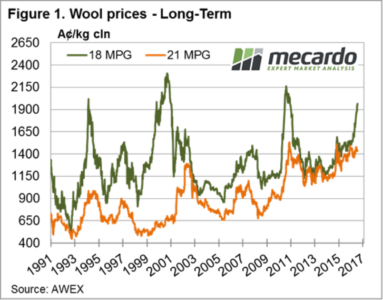
The question around at the moment is can fine wool continue to rally; will we see an increase in the premium (Basis) for fine wool over medium wool as the clip shifts broader as a result of the improved seasonal conditions? What is the nett effect of recent decisions by Merino sheep producers to re-focus on meat production alongside their traditional wool focus? Historically a push to bigger sheep and more lambs meant a broader micron from these sheep; but has the advances in breeding for wool quality evident over the past 20 years negated this usual outcome?
 As Mecardo reported, 21 MPG types were up 34% in volume for the 3 month period, continuing the trend of moving wool across the micron spectrum. The bottom line is that increases in the 20 – 22 micron types are at the direct expense of volume in the 17 – 19 micron categories. Even if the Autumn break is poor, cheap grain prices should mean that sheep are maintained in peak condition again maximising performance but also continuing the pressure on the clip to move broader.
While we can speculate that the long-awaited rally for fine wool will be the saviour of the industry and reverse the trend away from Merino sheep, the reality is that the market will need some time to adjust after a long period of relatively cheap fine wool. Countering this though is the fact that the world wool processing industry has as a result of cheaper fine wool prices become accustomed to using the finer types; cheap basis and plenty of volume over the past 4-5 years has encouraged greater demand.
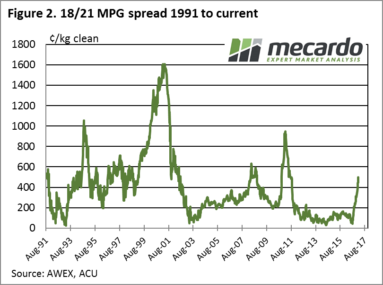
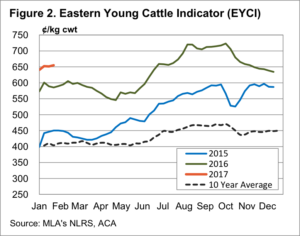
We also know that fine wool rallies can become price spikes; the problem is that price spikes in the past have been short-lived. Figure 2 shows that the spikes in September 1994, June 2001 and March 2011 were followed by severe corrections. Could this time be different?
This week Riemann traded solid volumes, however most of the action was in the 19 MPG tenor, a big change from volume traded over the past 4 – 5 years which has been 21 MPG focused. This is reflecting where buyers now have their concern; so perhaps it would be prudent for wool growers to take a contrarian approach and focus on 21 MPG contracts to protect future production. This is a good time to discuss with either your broker or Mecardo the type and tenor of forward contracts; high prices and potential further upside for fine wool making an interesting case for trading Basis, something the good grain traders regularly exploit to advantage and worth considering for the next wool clip.
The week ahead
Next week Melbourne is selling over three days with Fremantle and Sydney on Wednesday & Thursday. The strong market has again enticed 47,500 bales to be listed for next week, however forward projections for the following weeks trail off to 40,000 and 43,000.

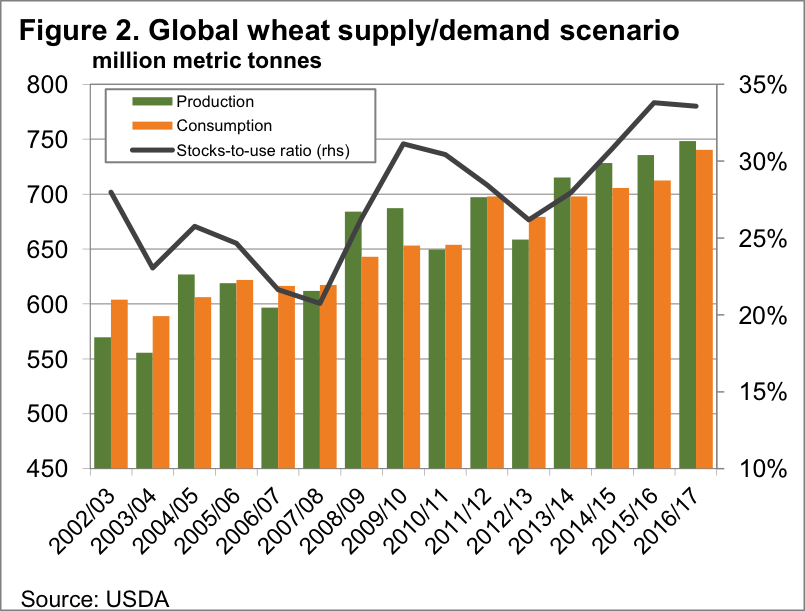
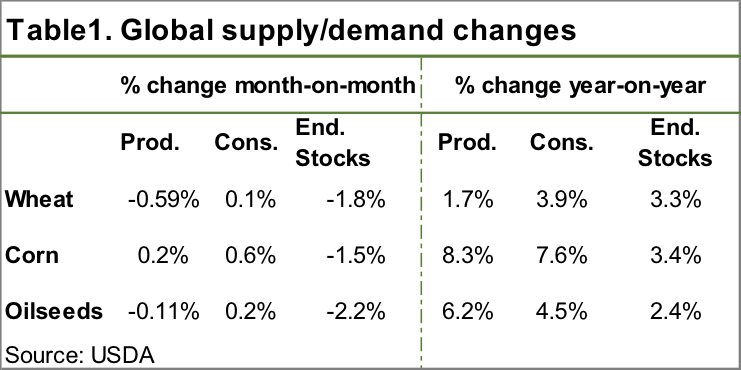 World wheat production was cut by 4.4mmt this month, largely thanks to a downgrade in India. The United States Department of Agriculture (USDA) are still saying 2016-17 will be the biggest crop on record. However, a small increase in consumption (Table 1) and a decrease in ending stocks saw the stocks to use ratio decline from 34.2% to 33.5%. Sounds small, but as shown in figure 2, the stock to use for 16/17 is now smaller than last year.
 In theory, a smaller stocks to use ratio should mean higher prices than last year. This had funds jumping out of wheat last night, pushing the CBOT spot contract to a 7 month high of 442¢/bu (figure 3). Still a long way from the 500¢ of February 2016.
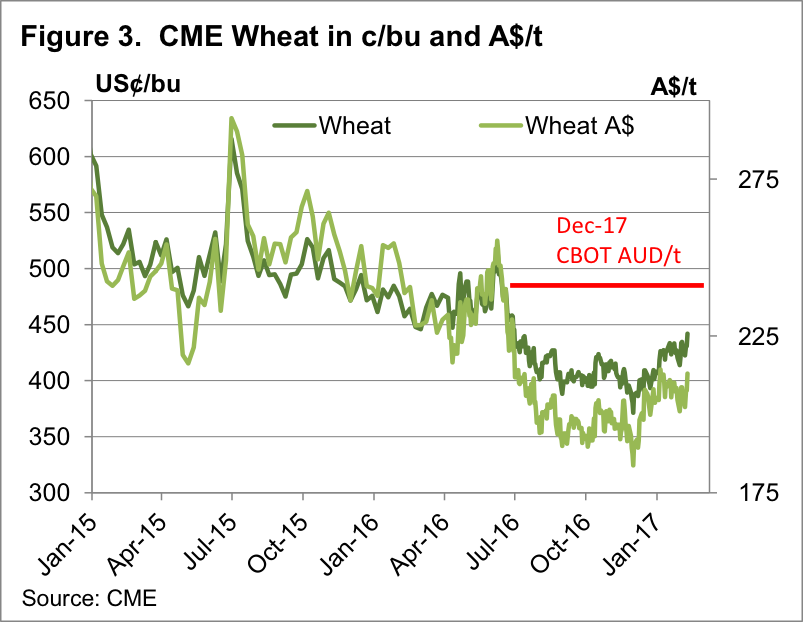 In our terms the stronger AUD sees prices just below the 7 month highs hit in January, with the spot contract at $213/t, up $5 for the week, and Dec-17 at $238/t, shown by the red line on figure 3. There is full carry into Dec-17, and those concerned about prices ticking along at current levels for another year might be tempted to sell a bit at these levels.
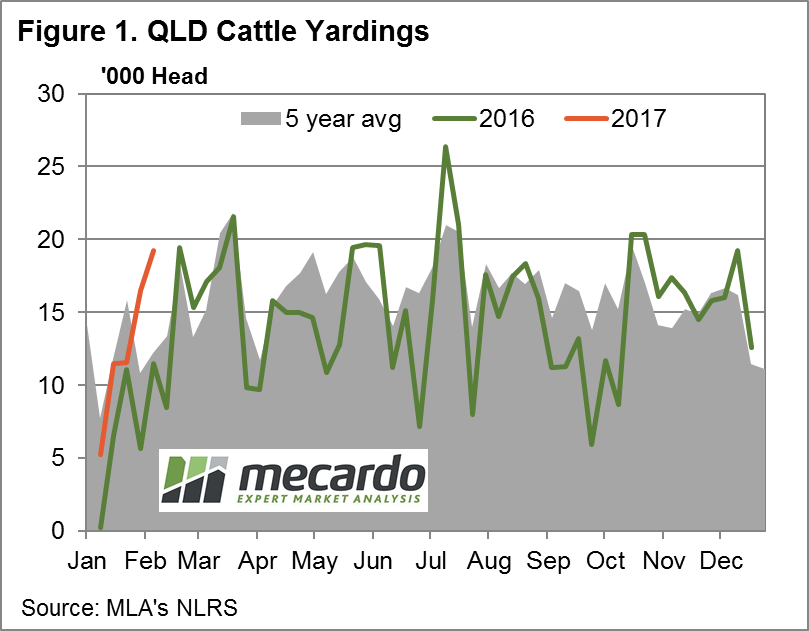 Surging weekly Queensland throughput and above average NSW throughput weighed on cattle prices in these regions dragging down the east coast figures this week with the Eastern Young Cattle Indicator (EYCI) dropping to levels not seen since the start of the season.
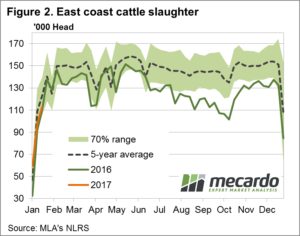
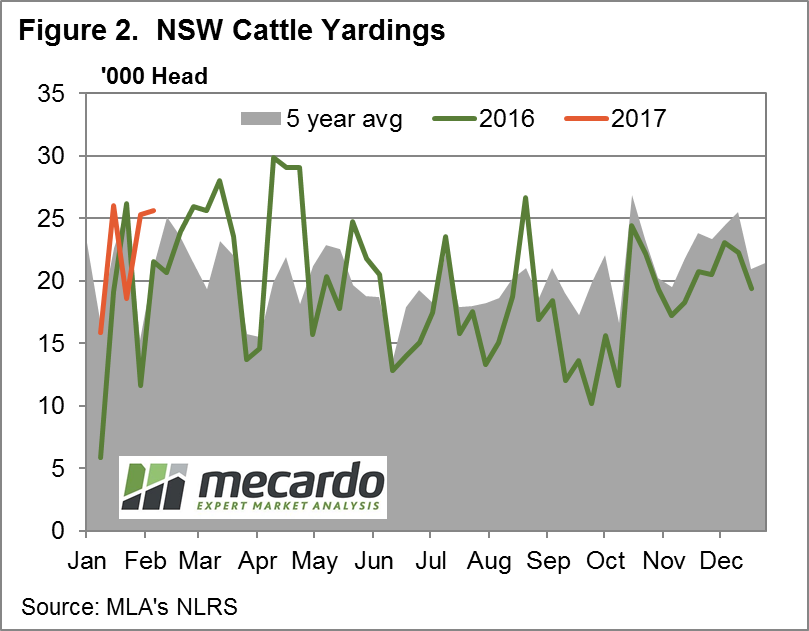 NSW experiencing price declines in all NLRS saleyard categories, apart from Medium and Heavy Steers, with Trade Steers headlining with the biggest percentage decrease, down 6% to 332¢/kg lwt with elevated NSW throughput appearing to contributing to the price pressure – figure 2.
 Register
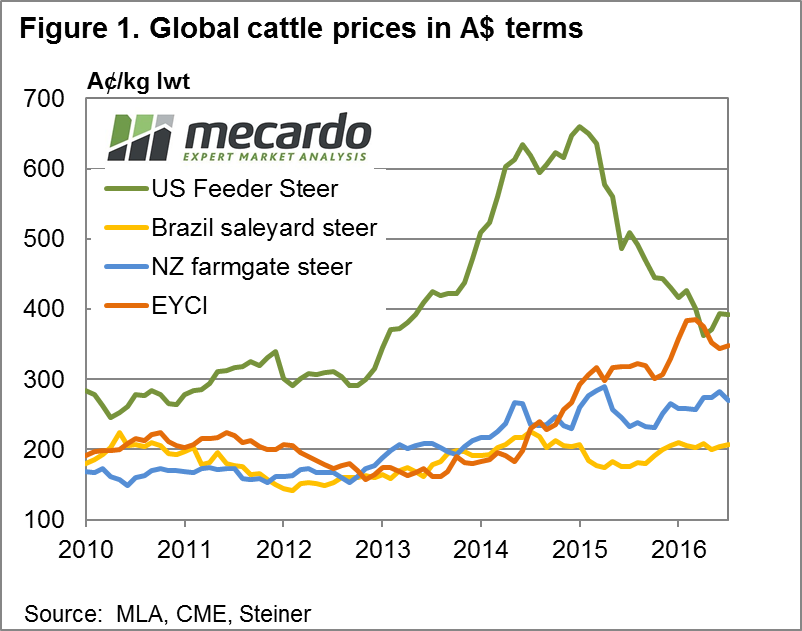 Often at Mecardo we look at local and global cattle price relationships in US$ terms as the US cattle market is one of the key drivers of Australian cattle prices over the longer term. However, in this analysis we flip the magnifying glass to take a look at global prices in our terms.
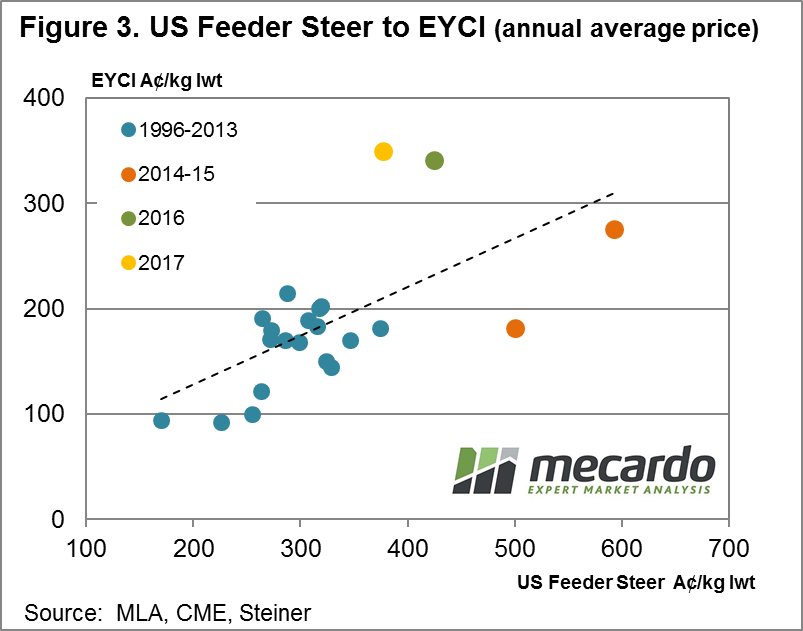
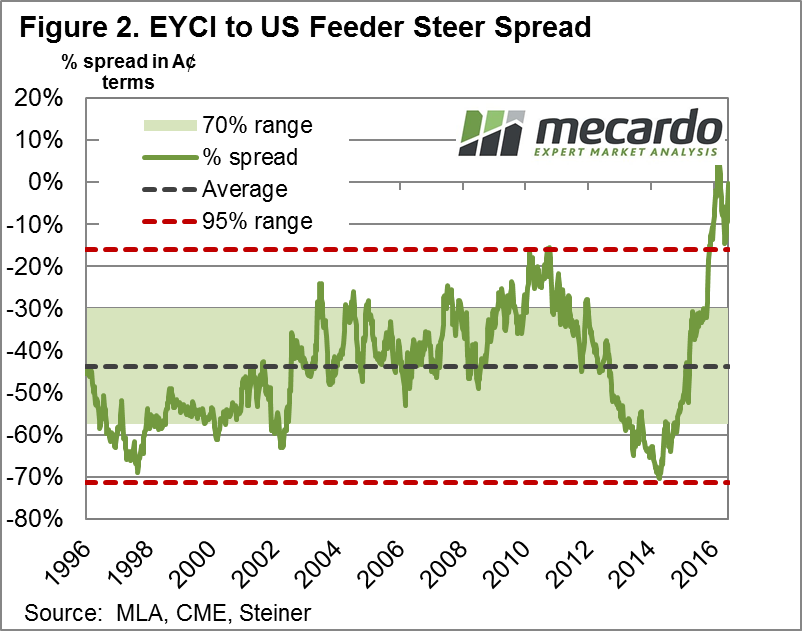 Taking a look at the correlation between US Feeder Steers and the EYCI we can see a moderately strong relationship between the two series when looking at annual average prices expressed in A$ terms – figure 3. Although,
  The lift in US prices since October has taken some of the downward pressure off local prices. Although from a longer term historical perspective local prices remain in overvalued territory and have not been helped by a stronger A$ during January.
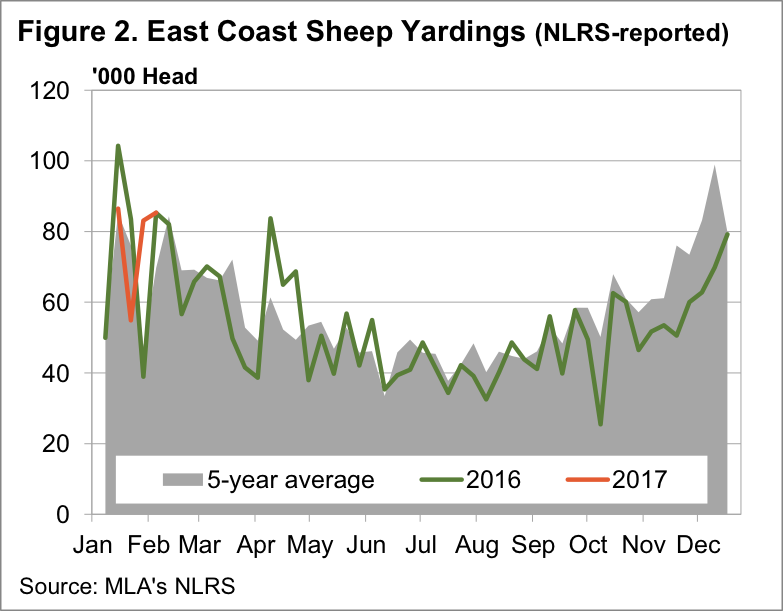
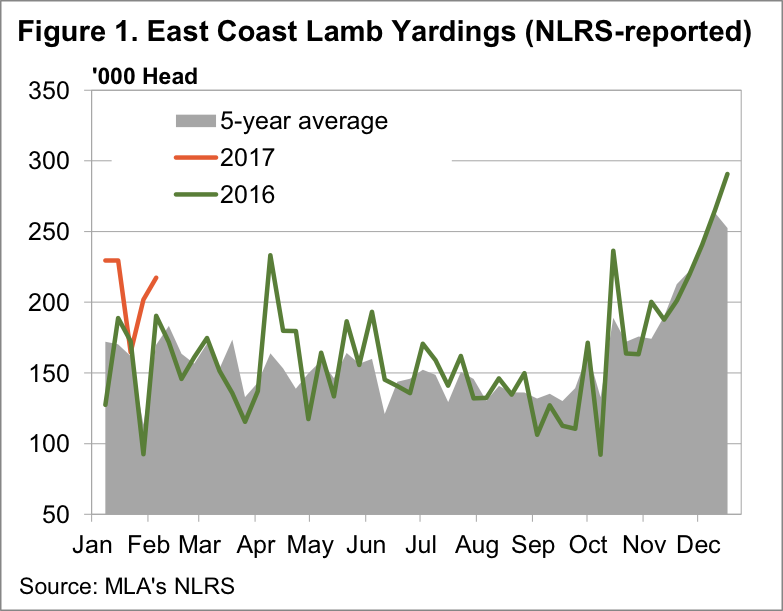 The very high prices seen last week had the desired effect for processors, drawing out very large lamb numbers, and sending prices lower. Sheep are a bit of a different story, especially in Victoria, where yardings waned, and as such prices have largely held their ground.
 The fall was strongest in Victoria, where trade lambs lost 45¢, or 7%, and moved back into line with NSW and SA.
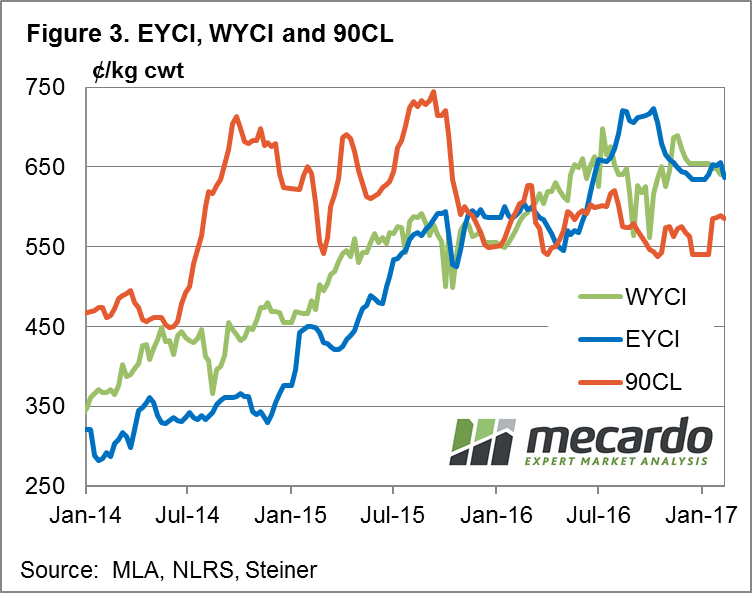
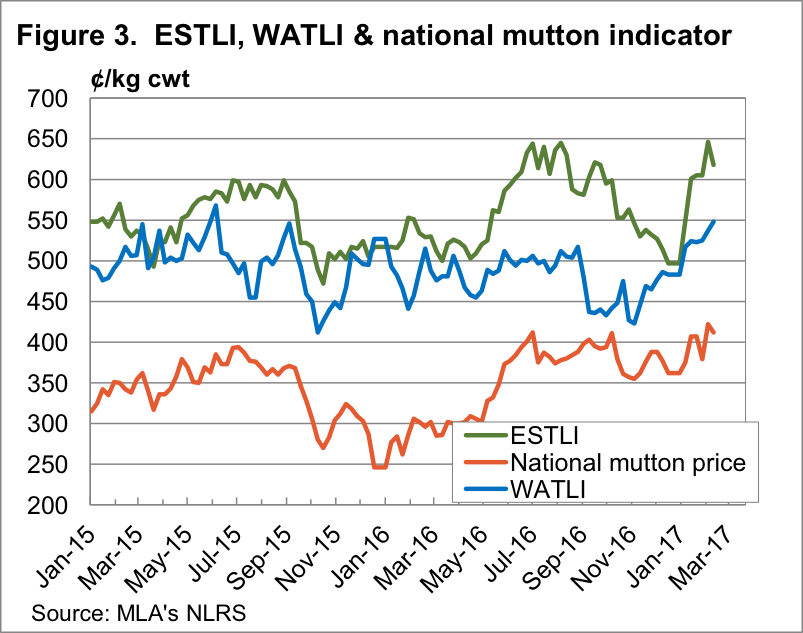 In WA lamb prices continued to play catch up to the east coast, with the WA Trade Lamb Indicator (WATLI) hitting a 19 month high of 548¢/kg cwt (figure 3).
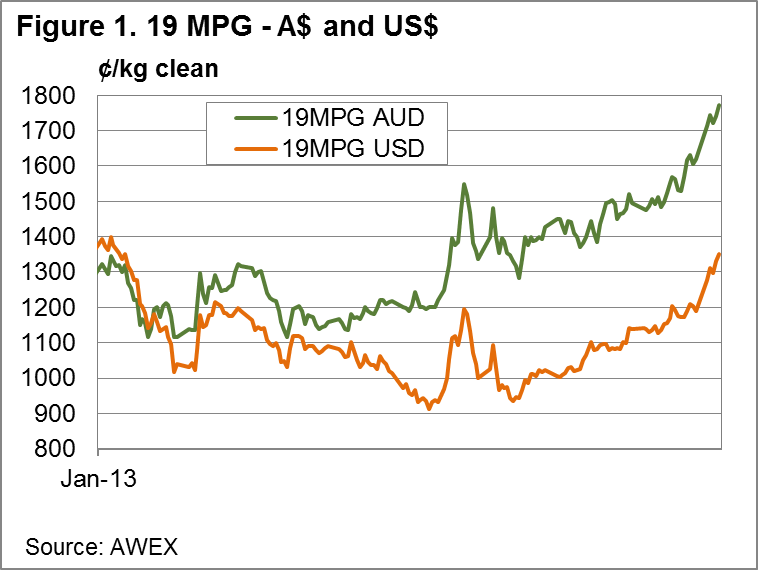 The good news for the wool market continued; again, it was the fine wool that was the stand-out and led the market. Sydney had a designated fine wool sale; this came at the perfect time for NSW fine wool growers resulting in the Merino fleece and skirtings component having an almost total clearance with only 1.6% Passed In, compared to the national PI rate of 6.7%. The EMI was up A$0.15, while in US$ terms it was 9 cents better.
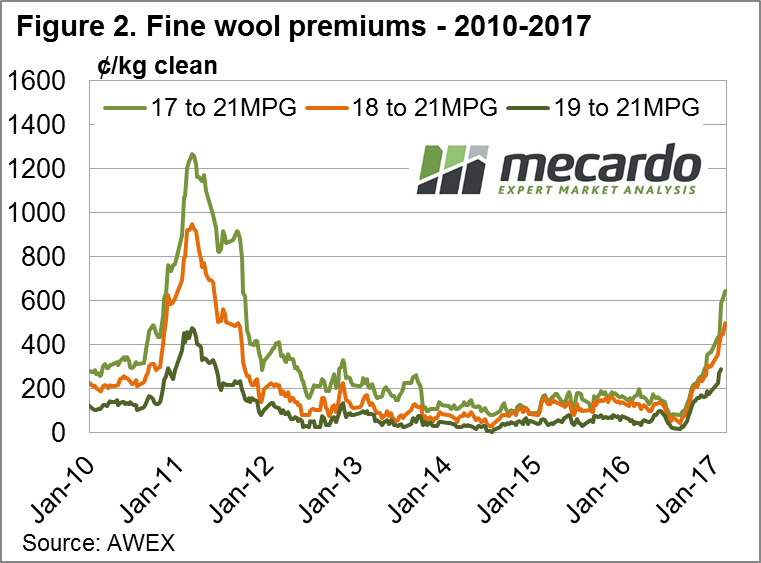 The last time 18MPG basis was at this level was July 2011 (Fig 2). Of further note is that in July 2016 (last year) it was quoted in Melbourne at 52 cents. Is that a 900% increase in less than 12 months?
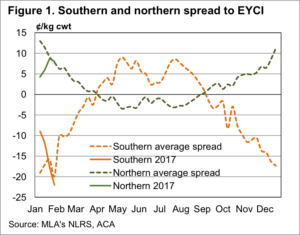 ements suggest this will again be the case, so what does this mean for pricing over the coming months.
 More interesting is what happens from there with the southern spread to the EYCI. Over February, March and April, the southern discount becomes a premium, as the supply of grass finished cattle tightens, as grass supply wanes.
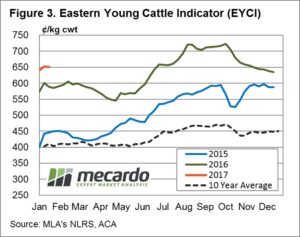
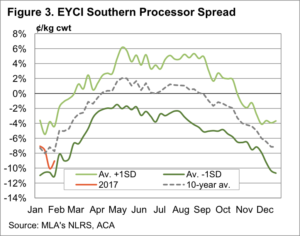 It young cattle destined for slaughter, or trade steers and heifers, which are set to benefit the most over the coming months. Figure 3 shows that young cattle sold to processors improve 8% over the late summer and autumn. From the current level of 595¢/kg cwt, a narrowing of the discount to parity, would see the price reach 630-640¢/kg cwt. Prices haven’t been this good since October.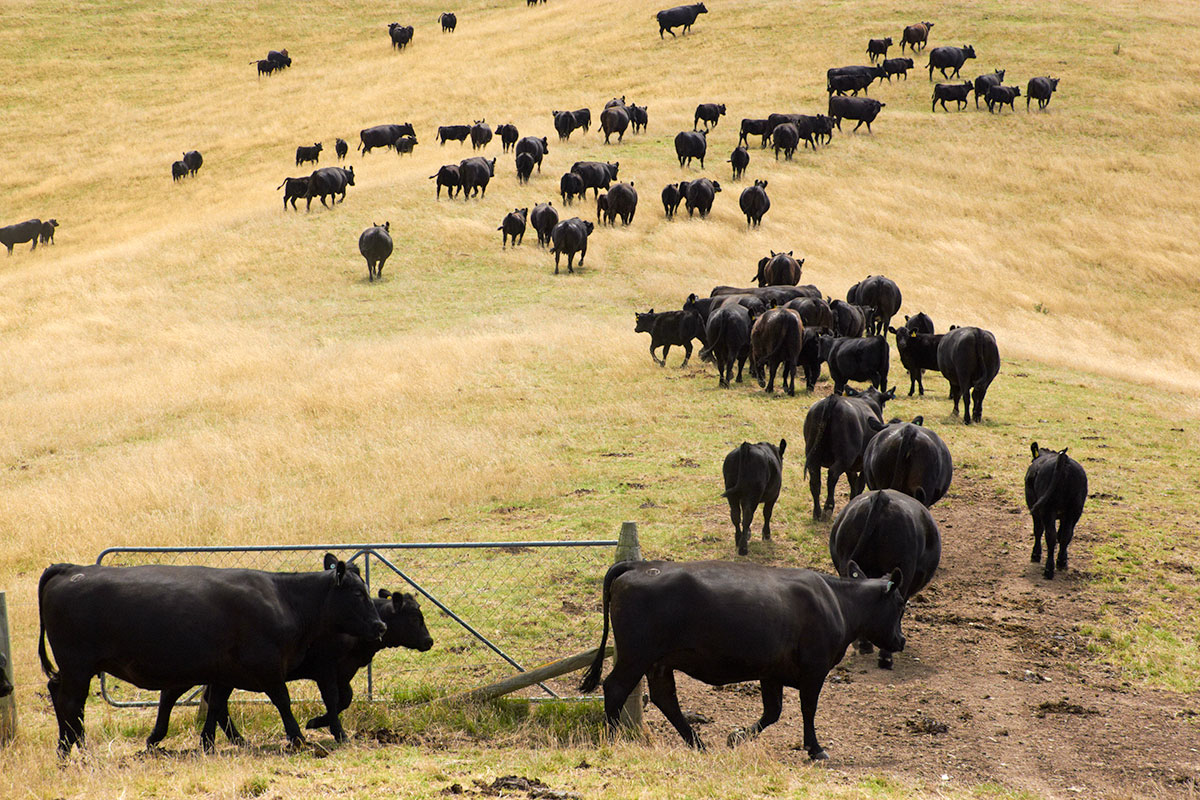
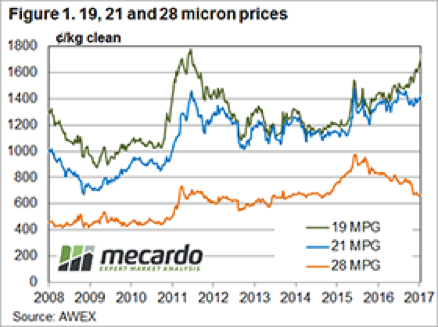 The response from three wool brokers this week when asked about the wool market was unanimous – it’s extremely good if you have wool 19 micron and finer, its good if you are in the “bread and butter” 20 to 22 micron range, and it’s terrible if you have crossbred types. This reinforces the concept that the wool market is not homogenous, it’s made up of a variety different markets.
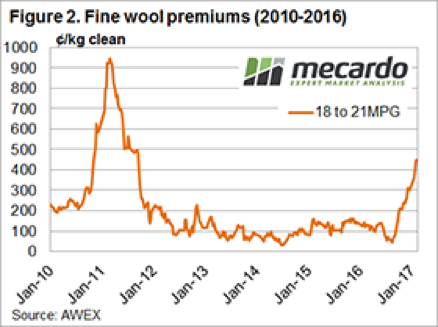 Fine wool has finally come out of the shadows and remerged to show good premiums over the mainstream types, the concern with the trade now is that this incentive for fine wool producers to continue with this specialty product has come too late for some. The fine wool premium as shown in Fig 2, identifies that the 18 premium over 21 MPG is now at a record not seen since September 2011